Roundhouse
The first roundhouse in Martinsburg was constructed in 1849. The original Martinsburg Roundhouse was built in the Gothic revival style with pointed arches that distinguished the different bays. Its turntable was 40 feet in diameter. This roundhouse was in operation from 1849 to 1862 when it was burnt down by the Confederacy during the Civil War.
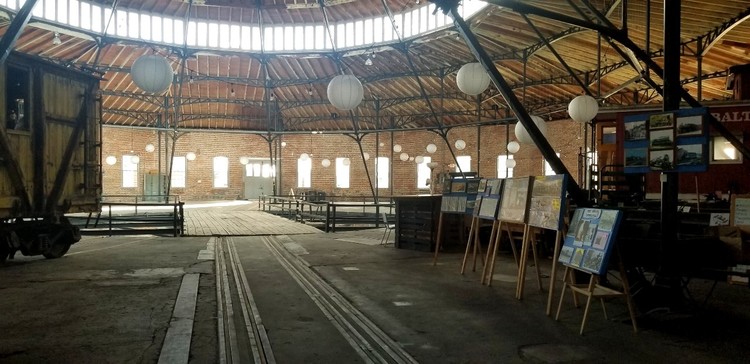
Following the end of the Civil War, the Baltimore and Ohio Railroad company then rebuilt a roundhouse in Martinsburg. The new roundhouse was completed in 1866. The building is 177 feet in diameter and is 68 feet and 6 inches tall. Other than the size there are a few key components to the roundhouse; the bays, the turntable, the framework, and the cupola.
The first key feature of the roundhouse is that it had 16 locomotive bay doors. In the mid to late twentieth century, the interior of the roundhouse was partitioned with each bay designated for specific jobs, including a weighing station, a sign shop, a plumbing shop, a carpenter shop, and work pits. Each different area allowed the employees to fully service the trains’ needs. These partitions were removed in the restoration of the Martinsburg Roundhouse.
The next important feature of the roundhouse is its turntable which was built in 1866. The turntable is 50 feet wide and 8 feet deep, this is a 10-foot increase in size from the original roundhouse turntable. This increase was made to accommodate the increasing size of locomotive engines. The table was initially turned by hand and it only took two people to turn it, even with a train on it, as it was so perfectly balanced.
The framework of the roundhouse is one of its most prominent features. The frame is cast-iron which was cast in Baltimore and transported via the railroad to Martinsburg. It was then erected and bricked. The frame is based on designs by Albert Fink, chief engineer of the B and O company from 1852-1857. The Martinsburg Roundhouse is the only one of its kind remaining in the United States.
Finally, is the cupola. A cupola is a small dome-like structure on top of a building. Best viewed from the center of the turntable is the cathedral-like ceiling. The inclination of the ceiling draws the air upwards. The cupola with its slotted windows allows for that air to escape, providing ventilation for the building. Not only would the steam from the engineer make the roundhouse hot, but that steam could be lethal. This cupola and the ventilation it provided was crucial when trains came into the roundhouse.
This National Historic Landmark is defined not only by its architectural features but also by its history.
-
Washington Hall
-
McGlothlin-Street Hall
-
Old Campus Residence Halls
-
Integrated Science Centers
-
Andrews Hall
-
Phi Beta Kappa Memorial Hall
-
Morton Hall
-
Jones Hall
-
Small Hall
-
Swem Library
-
Crim Dell Bridge
-
Sadler Center
-
Cohen Career Center
-
Zable Stadium
-
James Blair Hall