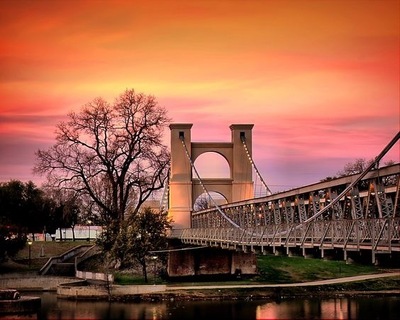
Waco Suspension Bridge
One of the most famous landmarks in Central Texas is the Waco Suspension Bridge. The Suspension Bridge is a 475-foot structure that crosses the Brazos River in downtown Waco. When it was built in 1870, it was the longest single-span suspension bridge west of the Mississippi River.
Before 1869, crossing the Brazos River was a time-consuming and sometimes dangerous ordeal. The only way to cross the river prior to the bridge was via the Shapley Ross Ferry.
The New Jersey firm of John A. Roebling was chosen as the designer of the bridge. It is the same company that built the Brooklyn Bridge.
The City of Waco charged a toll in 1870, 5-cents per person, or 5-cents per head of cattle to cross.
Over the years, the wood planking was upgraded and replaced. In 1913, the City replaced the older steel with higher gauge steel to handle the heavier traffic and trusses were added to accommodate pedestrian traffic. The brick towers were rebuilt and stuccoed, giving the structure virtually the same appearance it has today. The bridge was designated in the National Register of Historic Places in 1970 on its centennial anniversary. It was retired from vehicular traffic the following year but is still in continuous use for other traffic and events.
The Waco Suspension Bridge will close for two years as it undergoes renovations to ensure the safety and preservation of the bridge. Tom Balk, senior park planner for the City of Waco, will oversee the rehabilitation of the bridge. The project is expected to last 24 months and cost $5,400,000.
-
Washington Hall
-
McGlothlin-Street Hall
-
Old Campus Residence Halls
-
Integrated Science Centers
-
Andrews Hall
-
Phi Beta Kappa Memorial Hall
-
Morton Hall
-
Jones Hall
-
Small Hall
-
Swem Library
-
Crim Dell Bridge
-
Sadler Center
-
Cohen Career Center
-
Zable Stadium
-
James Blair Hall