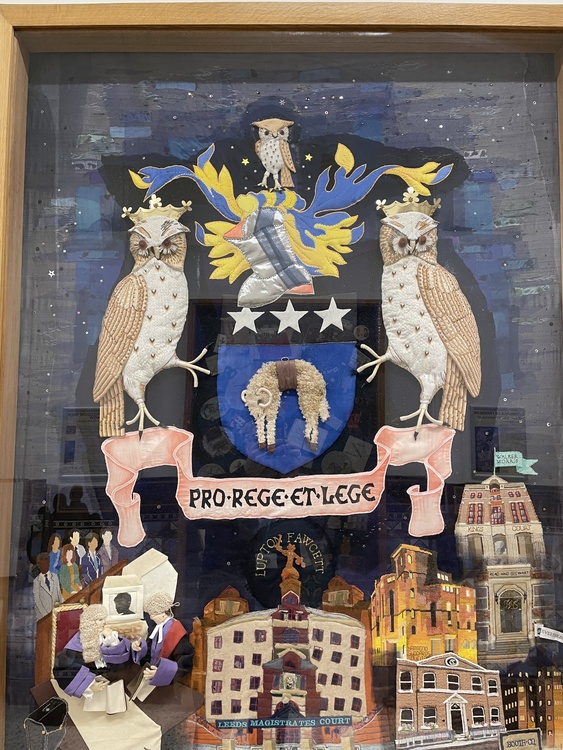
Pro Rege Et Lege 1992-1995
The panel, Pro Rege Et Lege, holds a significant place as the earliest completed piece in the tapestry collection, with Kate and her dedicated group of volunteers beginning their work in 1992 and finishing in 1995. This panel’s central theme is law, designed to honor and celebrate the legal sector in Leeds. Every element depicted on the panel is carefully chosen to reflect connections to law or authority, creating a rich visual narrative that pays tribute to the city’s legal heritage.
The Latin title, Pro Rege Et Lege, translates to ‘For King and Law.’ This phrase is not only apt for the legal motif of the panel but also carries historical importance, as it appears on the Leeds City Council’s coat of arms. Fittingly, the top of the panel features an embroidered representation of this coat of arms, which serves as a powerful emblem for the city and its governance.
A closer look at the coat of arms reveals a combination of symbolic elements: owls, stars, a lamb, and a steel helmet. The owls, long associated with Leeds, have their origins with Sir John Saville, the first Alderman of the city. These birds are a recurring motif and are embroidered using the canvas work technique, a traditional form of counted thread embroidery. The stars are linked to Sir Thomas Danby, the first mayor of Leeds, and are brought to life using appliqué, a needlework method where fabric pieces are stitched onto a base to form intricate patterns.
The lamb on the coat of arms represents Leeds’ historical connection to the wool industry, a key part of the city’s development, while the steel helmet symbolizes civic authority. Both the lamb and the helmet are embroidered using the appliqué technique. Beneath the coat of arms, the panel illustrates various people and buildings tied to law and authority. Prominent figures include a jury in court, a police officer working at a switchboard, and another officer accompanying a defendant clad in a distinctive 1990s shellsuit. Central to the composition is the imposing Leeds Magistrates Court, with surrounding buildings representing law firm sponsors who supported the tapestry’s creation.
The right side features the entrance to Booth & Co Solicitors, one of the first companies to sponsor the tapestry. In the bottom right, a prisoner is shown in the Old Bridewell, a small prison located under Leeds Town Hall in the 19th and 20th centuries. This prisoner is modeled after Charles Peace, a notorious criminal executed in 1879. Peace’s time at Old Bridewell before his trial has inspired ghost stories around the Town Hall ever since. On the bottom left, three judges are depicted in court, a scene embroidered by Sue Hodgson, who spent 52 hours using stumpwork—a technique that gives the figures a three-dimensional effect. This section played a crucial role in securing the tapestry’s initial sponsors, as Kate Russell presented it to solicitors, impressing them and earning generous donations to support the ongoing project.