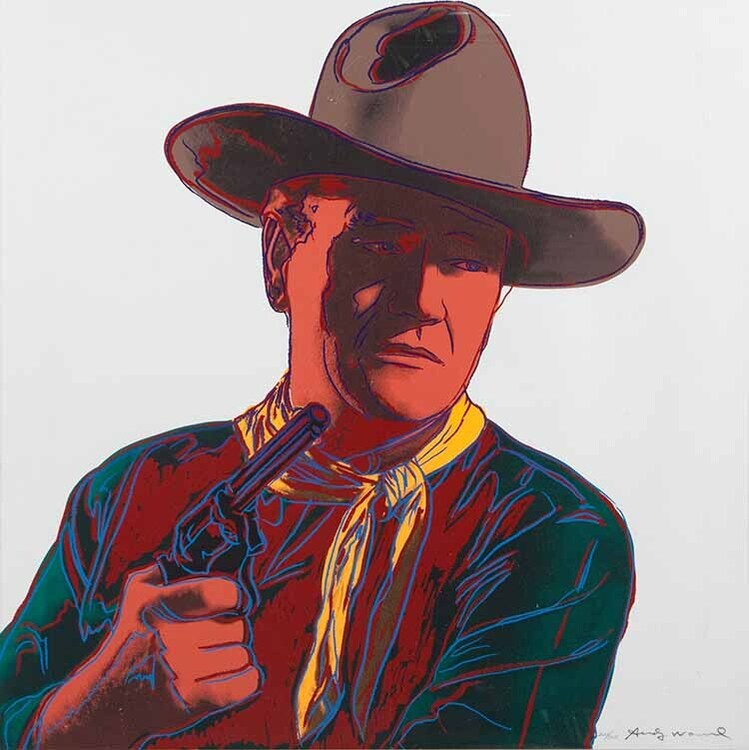
Cowboys and Indians (John Wayne)
Cowboys and Indians Portfolio (1986)
Warhol’s Cowboys and Indians portfolio (1986) was suggested to him as a subject by investment banker–turned–print publisher Kent Klineman. During contract negotiations for the Cowboys and Indians series, Klineman secured the unusual right of final approval over the images. This arrangement created tension between artist and publisher, with disagreements over subjects, colors, and image rights. Warhol drew from a range of sources, combining historical photographs, publicity stills, and his own Polaroids. His photographs of a kachina doll and a painted shield—taken during a visit to the National Museum of the American Indian (NMAI) in late 1984 or early 1985—were incorporated alongside imagery of figures such as Annie Oakley, John Wayne, and Sitting Bull. The series was first exhibited at the NMAI in June 1986.
The portfolio reflects Warhol’s ongoing fascination with mass media, celebrity, and the construction of American myth. Growing up on the Western films of the 1930s and ’40s, he approached these figures with his signature style. Rendered in flat, vivid color and silkscreened repetition, his images collapse distinctions between Native leaders, Western entertainers, and Hollywood cowboys—an effect that simultaneously critiques and risks perpetuating the simplified identities circulated by popular culture. While Cowboys and Indians presents a vision of the American West steeped in myth and nostalgia, it also invites reflection on how mass imagery can both define and distort cultural identity.
Drawn from a publicity photo of John Wayne for The Man Who Shot Liberty Valance, this image was the subject of litigation by the actor’s heirs. The lawsuit was resolved when Warhol provided the family with a complete set of the series and multiple color variations of the print, which were later auctioned.
Cowboys and Indians (John Wayne)
1986
University of WYoming Art Museum
2014.9.4
-
Cow Wallpaper
-
Little Electric Chair
-
Paris Review Poster
-
Flowers (Red/Yellow)
-
Sunset
-
Kimiko
-
Joseph Beuys
-
Ladies and Gentlemen (Marsha P. Johnson)
-
Martha Graham (Satyric Festival Song)
-
Cowboys and Indians (John Wayne)
-
Cowboys and Indians (Annie Oakley)
-
Cowboys and Indians (Sitting Bull)
-
Cowboys and Indians (Mother and Child)