18. Eton Boat House
Eton Boathouse, known as ‘Rafts’ is where the boats (known as elites and whiffs) were built and kept for many years.
Rowing has been a feature of Eton school life since the late 18th century, though initially it was discouraged due to the dangers of commercial traffic on the Thames and the perils of the local sewer.
There has been a Procession of Boats on the Fourth of June and Election Saturday as early as the 1790s.
The first race between Eton and Westminster took place in 1829. Rowing was recognised formally by the College in 1840 and since 1860 has been actively encouraged.
There were various boathouses by the mid 1800s and by 1895 the Eton College Boating Company had established its own boathouse, renamed the Eton College Boating House in 1910.
Boating became particularly popular after 1910 with a record number of ‘wet bobs’ (boys who rowed, as opposed to ‘drybobs’ who were cricketers).
The College purchased the freehold as late as 1978. Here all the boats were built until the College sold the freehold in 2012, retaining some existing bays for boat storage.
Today it still houses 38 house bumping fours, 30 coxed doubles, 50 tracers, 70 whiffs, four gigs and two dragonboats.
The Junior Fours (known as House Bumping Races) are still raced from Lower Hope (where the Thames meets the sea) to Rafts in Eton over four nights in the summer, and boys still row upriver to Queen’s Eyot near Boveney Lock.
Eton has produced many rowing Olympic Gold medallists including Sir Matthew Pinsent (1992, 1996, 2000 and 2004), Ed Coode (2004), Andrew Lindsay (2000) and Constantine Louloudis (2016).
Recently, the Eton Rowing Lake was constructed at Dorney and now rowing activities are largely based at the Dorney and Andrews Boathouses.
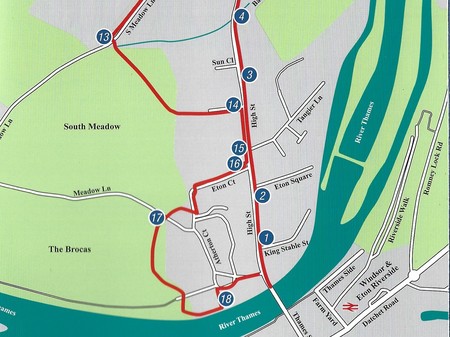
At the Boathouse, turn left through a covered passageway which soon joins Brocas Street.
Turn right at Brocas Street and complete the Eton Walkway by walking about 80m back to the Windsor Bridge.
-
Introduction
-
[Red Doors] Station 1: Jesus is condemned to death
-
[Black Lives Matter art, Pride flag] Station 2: Jesus takes up his Cross
-
[Accessibility ramp] Station 3: Jesus falls for the first time
-
[Chicken Coop on Napa] Station 4: Jesus meets his Mother
-
[Epworth Playgroups] Station 5: Simon of Cyrene helps Jesus carry the Cross
-
[Low Water Landscaping, 1926 Napa Avenue] Station 6: Veronica wipes the face of Jesus
-
[Vote Sign, 1918 Napa Avenue] Station 7: Jesus falls for the second time
-
[Stone obelisk, The Alameda and El Dorado] Station 8: Jesus meets the women of Jerusalem
-
[Flag showing solidarity with Ukraine, 1110 The Alameda] Station 9: Jesus falls for the third time
-
[Berkeley Fire Station, No. 4] Station 10: Jesus' clothes are taken away
-
[Dentist office] Station 11: Jesus is nailed to the Cross
-
[Jerusalem Kitchen] Station 12: Jesus dies on the Cross
-
[Northbrae Tunnel] Station 13 & 14: The body of Jesus is taken down from the Cross and is laid in the tomb
-
Closing Reflection