The Burning Bush is a listed lamppost from the Victorian era sited outside the School Hall and the School Library which are memorials to the Boer War.
It was designed by Henry Woodyer, an Old Etonian and specialist church architect, with elaborate wrought iron flower heads, depicting fleurs-de-lys and lilies, which are integral parts of Eton’s coat of arms.
Originally it was designed to stand in New Schools Yard (also designed by Woodyer) on the opposite side of Common Lane. However, it was displaced by the Russian cannon you can now see there (captured at Sebastopol in 1855, and given to the college in 1867).
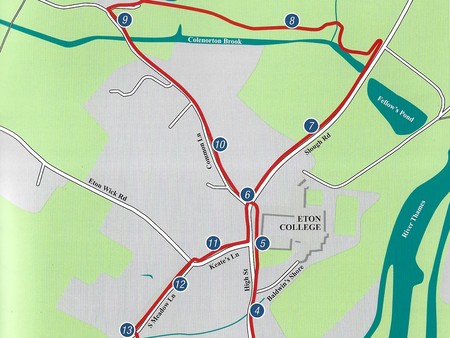
Instead then, the Burning Bush stood in the Slough Road from 1864 for nearly a hundred years.
In 1963, an island was created to help boys cross the road safely and the lamp was moved to its present position.
It is a significant Eton landmark and meeting place. Until quite recently, Masters used to gather in School Hall every mid-morning school day for "Chambers," and boys who wished to see a Master would wait by the Burning Bush to speak with him.
Chambers now takes place in Upper School.
School Hall and School Library were built in the English Renaissance style as a memorial to Etonians killed in the Boer War and were opened by King Edward VII on 18 November 1908.
School Hall replaced two small boys’ houses and is used to host concerts, plays, films, examinations and other large gatherings.
School Library was built with a dome and cupola, affording maximum floor space and minimum shelf space, and serves as a first-rate reading and reference library, available to all members of the Eton community.
Cross Common Lane and follow the footway on the main road for 220m to lamp post number 007.