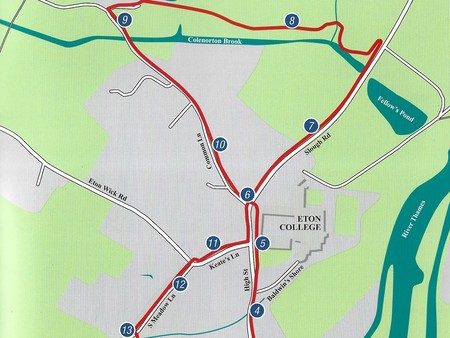
Eton College occupies almost all of the town to the north of Baldwin's Bridge.
The College was founded by Henry VI in 1440 and dedicated to the Virgin Mary.
There is a memorial on the external wall of College Chapel to William de Waynflete (1398-1446), Bishop of Winchester, and the second Provost of Eton, who paid for the completion of the chapel from his own funds.
The main College buildings were built round two quadrangles. The larger of these is School Yard.
Surrounding this are the original school buildings, including: Upper School (1689-1694); the Gothic-style College Chapel (1448-1482); and the dormitory accommodation where the King’s Scholars work and sleep.
In 1940, Upper School was bombed and the windows of the chapel were destroyed.
School Yard also contains the bronze statue of Henry VI designed by Francis Bird in 1719.
Also in School Yard, King George VI knighted the then Provost, Sir Henry Marten, on 4 March 1945, watched by the present Queen, Queen Elizabeth (the Queen Mother) and Princess Margaret. Sir Henry had privately tutored the princesses during the war.
The College buildings are not generally open to the public but the statue of Henry VI and Lupton’s Tower are visible through the main gates.
Beyond Lupton’s Tower (1517-1520) with its clock, lies the inner quadrangle surrounded by cloisters which contain the College Library, College Hall and the dwellings of the Provost, Vice-Provost and Headmaster.
Now, carefully cross the main road opposite the College main gates and turn right to find the next marker by the ornate lamppost outside School Hall and before Common Lane.