Ronaldson's Row (East side of 600 Block of S 9th St)
On S 9th St, we examine row house development. The following description is excerpted from Jeff Cohen, “Ronaldson’s Row,” in Vernacular Architecture Forum, A Guide for Philadelphia: Fortieth Annual Vernacular Architecture Forum Conference (2019).
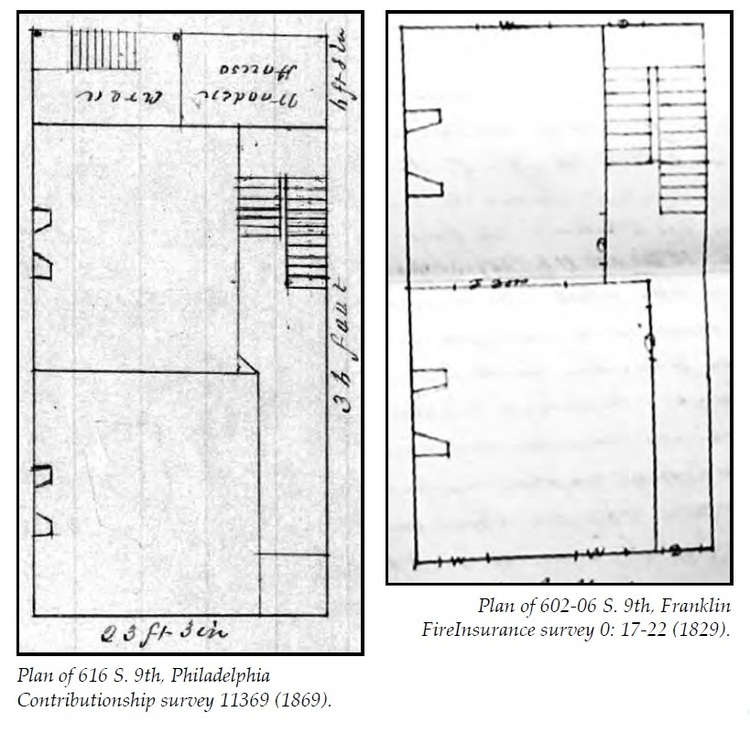
“In August 1829, six of the twelve houses in Ronaldson’s Row were documented in a set of surveys that was among the earliest policies issued by the Franklin Fire Insurance Company (policy numbers 17-22 in a series that would reach numbers over 74,000 by the late 1890s). These offered a description, site plan, and typical ground-story plan of a set of contiguous triplets in the row, present-day numbers 602-06 and 618-22, just in from the corners. All but one of these had frontages of 24 feet (606 was eight inches narrower) -- a substantial frontal breadth for repetitively designed rowhouses. The houses were insured for $1,000 each. Curiously, the four houses at center in the row, 608-614, differed from the rest, measuring only 20 feet wide, not noticeably distinct from the front, but different in plan. They were built from the start with their stairs pushed into a projecting rear ell, whereas the others had a simple rectangular perimeter. One of these narrower houses, 608, was insured earlier, in September 1828, with the Mutual Assurance Company, leading one to wonder if the rear ell was part of the original conception, at least for these middle houses, and if they were built earliest.
The development was a remarkably ambitious full-block row of townhouses, with a claim to being extraordinary in terms of size and apparent uniformity – in that regard, connected with some of the city’s grandest early residential row developments, including Norris Row (1790s, five 27’ fronts), Sansom’s Row (1800s, twenty-two 18’ fronts, designed by Thomas Carstairs), and Portico Row (early 1830s, sixteen 25’ fronts, by T. U. Walter), only slightly later than Ronaldson’s. But compared to them, these 12 houses were situated in what now and probably then might have seemed a rather unlikely place. It was some distance from the most central, prestigious residential districts, and lay just beyond the city’s southern boundary, then at South Street -- at a time when development below South Street and beyond 8th Street quickly grew sparse. And unlike most other ambitious rows, Ronaldson’s Row was sited on a North-South street, belatedly echoing an older, colonial pattern when many of the city’s leading families resided on South 3rd and South 4th streets, parallel to the waterfront, the source of much of the early city’s maritime mercantile wealth.
But among the wealthy seeking to demonstrate familial visibility through their large houses, streets leading westward from the old core had already come into the ascendancy. With this new row, the developer, James Ronaldson, wished to tempt the fashionable southward, hoping these houses’ apparent size (they were not as deep as one might have expected) and their large-scale, laconic ordering, quite stylish in the 1820s, would appeal, drawing aspiring purchasers to his investment on land that was not yet highly valuable.”
Image Source: Fire Insurance Surveys courtesy of Jeff Cohen, as above.