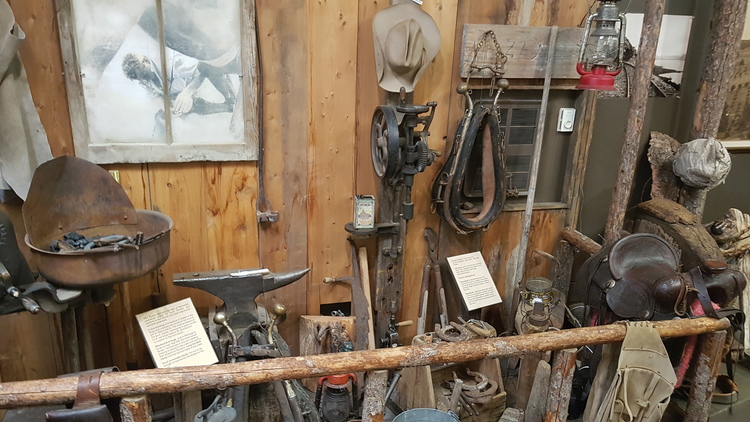
The Blacksmith
Future blacksmith, Bud Gawne, arrived in Naramata in May 1921, when his parents, James and Edith Gawne, travelled here from Saskatchewan in a Model T. It was an adventurous journey over wagon roads, on barges, and even detouring through the US before crossing back into Canada at Osoyoos. They came to join relatives already in Naramata: the Littlejohn, Munro, and Sammet families. The close-knit clan were known as The Thundering Herd.
When Bud grew up, he became the local blacksmith, and is fondly remembered by the townsfolk. In this display, you will notice the forge used for heating iron, and many of the tools that a smithy required.
Try to pick out the ice saw among the artifacts. Before refrigeration, ice blocks were cut from the lake during winter and insulated with sawdust in an ice house. Households would buy a block from the iceman to keep food fresh in the home's 'icebox'. After the harvest, large quantities of ice were placed inside boxcars that were loaded at the packing house so fruit would arrive fresh at markets. A photo on the back wall (circa 1920) provides a view of early Naramata orchards taken from the Kettle Valley Railway tracks that ran above the town.
The Kettle Valley Railroad, finished in 1915, provided a direct link westward to Vancouver and eastward to the USA. Rail traffic to eastern Canada, however, required rail cars to be barged between the Naramata Packing House and Okanagan Landing. Today, all that remains is the cold storage, now the Naramata Wine Vault.