Vietnam War Women's Memorial
The Vietnam Women’s Memorial was dedicated on the National Mall just yards from the Vietnam Veterans Memorial, the Wall, on November eleven, 1993. One might think that the approval, placement and funding of a statue for such a just cause would be a relatively simple process; after all, this was to be the first memorial on the National Mall to honor the military service of women.
But you’d be wrong; the struggle took ten long years, and included two separate pieces of Congressional legislation and the approval of three federal commissions. The dedication of the Vietnam Women’s Memorial was the culmination of a 10 year struggle by thousands of volunteers who overcame controversy, rejection, and challenge by those who thought that a women’s memorial was not needed.
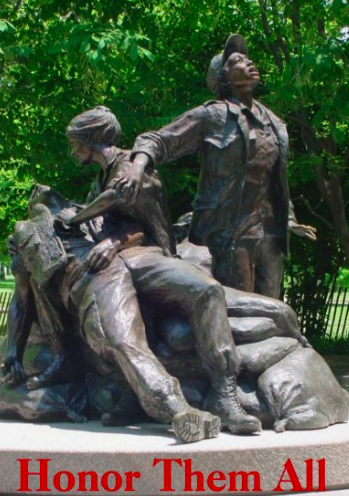
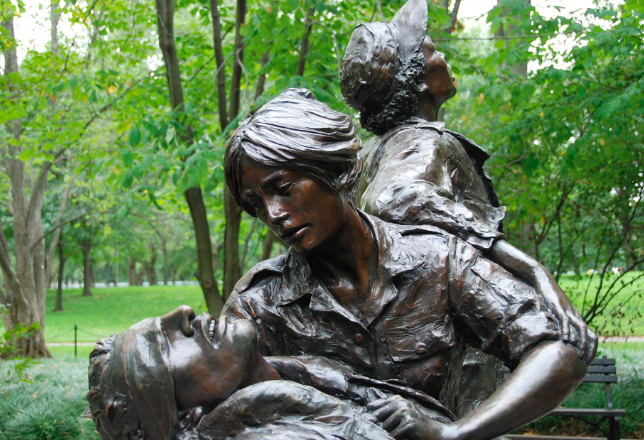
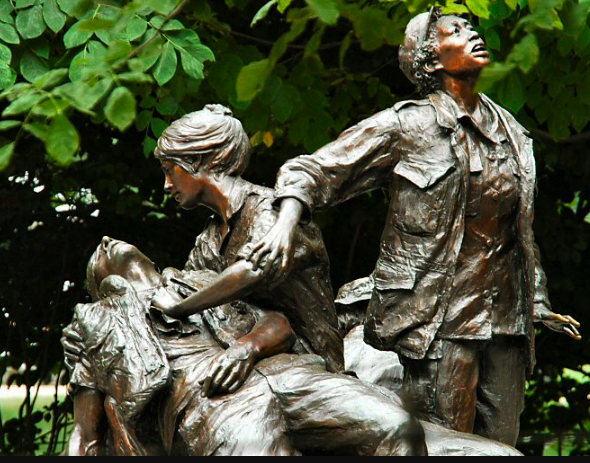
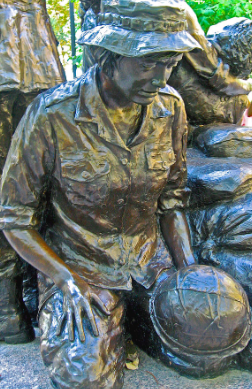
The sculpture, created by Glenna Goodacre of Santa Fe, New Mexico depicts three nurses. In the arms of the first nurse, Love, is a seriously wounded soldier with a significant chest wound. Note the compress in the nurses hand as she tries to stem the flow of blood. The second nurse, Faith, is on her knees, probably in prayer, holding the helmet. The final nurse, Hope, her right hand on the shoulder of Love, in support, looking skyward for the helicopter that, if it arrives in time, may save the life of the soldier.
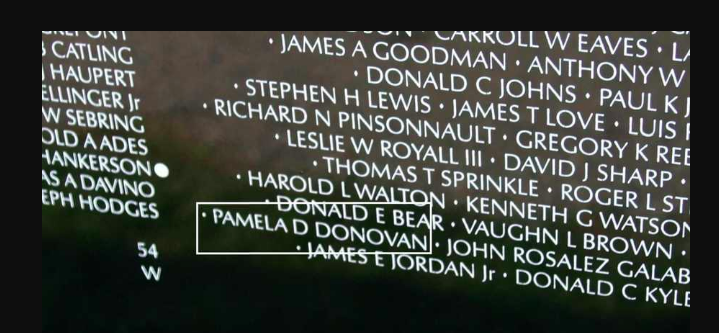
In all, eight nurses, of the more then 11,000 who served in Vietnam, all volunteers, lost their lives. One, 2nd Lieutenant Pamela Donovan was from Brighton, Massachusetts. Pam was born in Ireland, and when she was 8 years old, she and her family immigrated to the United States and settled in the Boston area. After graduating from Saint Elizabeth’s Hospital School of Nursing, Pam wanted to repay her new country that had provided her the opportunity to get a good education and a better life. She went to her local army recruiter and attempted to join. Sadly, he had to tell her that because she was not a citizen, she could not volunteer. Not to be so easily turned away, she visited her member of the United States House of Representatives, a man named Tip O’Neil. He made it clear that he would fast track her naturalization process, and within six months, Pam went back to the same army recruiter, and this time she was able to proudly serve her country. She was shipped to Vietnam in early June in 1968, and died on July 8th that same year. You can find her name on the Wall, panel 53 W, line forty-three.
Captain Mary Klinker of the United States Air Force, was part of an on board medical team during operation Baby Lift. Her flight was carrying 243 infants and children when a problem developed on the plane, and crashed while attempting to return to the airport. All on board were killed. Captain Klinker was killed April 4, 1975, just three weeks before the last American troops left Vietnam on April 30th that same year.
Captain Klinker is remembered on panel 1, line 122.
Eight trees surround the memorial, one for each of the 8 nurses who died during the war in Vietnam.
-
Introduction
-
The Farmhouse
-
Flowing Through Time
-
The Church
-
Transition
-
Mill Floor
-
The Treasury of Life
-
Stairwell
-
Baseball
-
The Triple Decker
-
The Mills Along the Blackstone
-
The Classroom
-
Woonsocket Industrialists
-
The ITU Hall
-
The Merci Boxcar
-
Introduction Alt Text
-
The Farmhouse Alt Text
-
Flowing Through Time Alt Text
-
The Church Alt Text
-
Transition Alt Text
-
Mill Floor Alt Text
-
The Treasury of Life Alt Text
-
Stairwell Alt Text
-
Baseball Alt Text
-
The Triple Decker Alt Text
-
The Mills Along the Blackstone Alt Text
-
The Classroom Alt Text
-
Woonsocket Industrialists Alt Text
-
The ITU Hall Alt Text
-
The Merci Boxcar Alt Text