Most of Keate House was built in 1788. It is named after Dr John Keate (1773-1852) who was Headmaster of Eton from 1809 to 1834.
He followed two weak headmasters, and being a man of unflinching character, was at first unpopular due to employing stern methods.
He was a small thickset man, with a short neck and short legs. Active and powerful, it was said of him that ‘within his small frame was concentrated the pluck of ten battalions.’
He looked like an angry bulldog, ‘ever ready to explode into rage.’
He dressed in an obsolete style, wearing a huge cocked hat - long after this had gone out of fashion, causing some to say he resembled Napoleon or a widow woman.
Keate sought to keep the old educational system going - with only five masters to help him.
He employed the birch to restore discipline, once flogging 80 boys in a morning, and he quelled numerous classroom rebellions.
Despite this, he earned the affection of his boys and was considered a good teacher.
W.E. Gladstone and Percy Bysshe Shelley were amongst his most famous pupils.
During his time, the Eton Society, known as ‘Pop’, was established in 1811 as a debating society.
In later life Keate was appointed a Canon of Windsor.
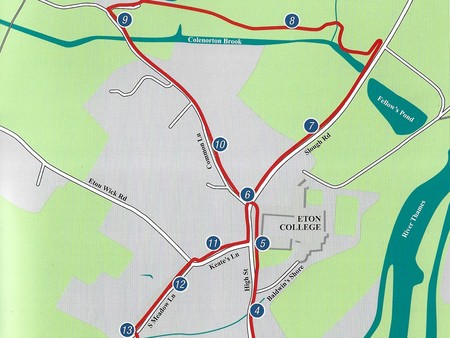
In Keate’s Lane, there are several boys’ houses, notably Hawtrey, Durnford and Evans’s (named after several generations of the Evans family, the last being the famous Eton Dame, Miss Jane Evans).
On the left hand side, a few yards along - on the side of Carter House, is a marker indicating where College Chapel would have reached had Henry VI had his way.
Take extra care crossing Keate’s Lane and turn into South Meadow Lane.
The Museum can soon be found on the left hand side.