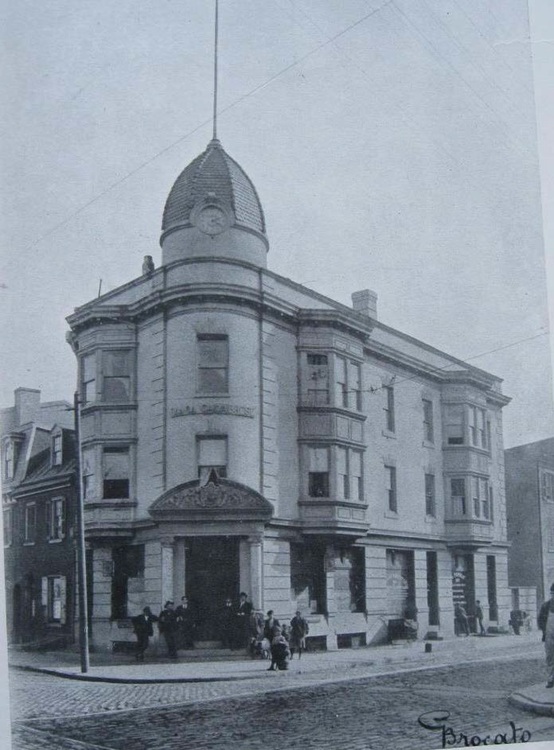
Italian neighborhood (Banca d'Italia)
In 2019, Philadelphia designated another bank building in the Bella Vista neighborhood (638 Christian Street, aka Banca Calabrese). The following text is excerpted from that nomination by way of offering context about this area of the city, as well as Italian “banks” (like Banca d'Italia) within it:
"The nominated "Banca Calabrese" building is in the Bella Vista neighborhood of South Philadelphia, formerly the "Little Italy" of Philadelphia. Its location is south of South Street, on the corner of South Seventh and Christian Streets which has always been a busy thoroughfare for centuries as it linked the Delaware River to the Schuylkill River. This area's location near the port of entry for late 19th century arrivals, held the most settlement houses, ethnic (eastern and southern European) social services centers and religious and cultural centers. Commercial activity was also here. By the time that Banca Calabrese arose in "1904," Little Italy's "physical center" was on Christian Street, between "6th and 9th Street" especially, wrote Richard N. Jululiani, Ph.D. an expert on Philadelphia's Italian community for over fifty years. Banca Calabrese's location was in the middle of the immigrant community and the early Italian "colony" described by Dr. Juliani from the 1850s. The older group had already established a "distinctive and separate social system" in Little Italy by about "1870," well before Frank R. Bilotta (1866-1941) built Banca Calabrese in 1904 as his office and home.
The building's name, “Banca Calabrese'' is legible on the corner entrance, above a cartouche with a bas relief of St. George slaying a dragon (an allegory to Satan), the patron saint of the area of Calabria at the "toe" of the "boot" of Italy. However, documentation has not supported that a "bank" began here. Unlike the numerous "banks" that arose during the "New Immigration" era (1880-1920) for the temporary worker to send his wages abroad, Banca Calabrese was not of this type of business. These "Italian banks" were unregulated and not under State control or any law.
The time of Banca Calabrese's construction in 1904 is relevant to the rise of new construction and new architectural design implemented in the late 1890s to early 1900s. What is of interest is that a building such as Banca Calabrese refers to the existence of Philadelphia's Little Italy, one of the first in the United States, and implies an "immigrant" community. This was partly true by 1904 when an established citizenry of American-born of Italian ancestry was - responsible for the new buildings rising mainly along Christian Street, where Banca Calabrese is located. Thus, while the building did not serve as a bank, its construction directly related to the times of developing a different appearance on Christian Street, the main street in the Little Italy neighborhood."
Morello, Celeste A. “638 Christian Street.” May 12, 2019. https://www.phila.gov/media/20190716102319/638-Christian-St-nomination.pdf
Image Source:
Banca Calabrese, circa 1905, as photographed by Brocato, whose images were published in the local Italian press from 1906 to 1910. Source: Michael DiPilla, South Philadelphia's Little Italy and 9th Street Italian Market (Charleston, South Carolina: Arcadia Publishing, 2016), p. 64.