Mount Locust Historic House, Milepost 15.5
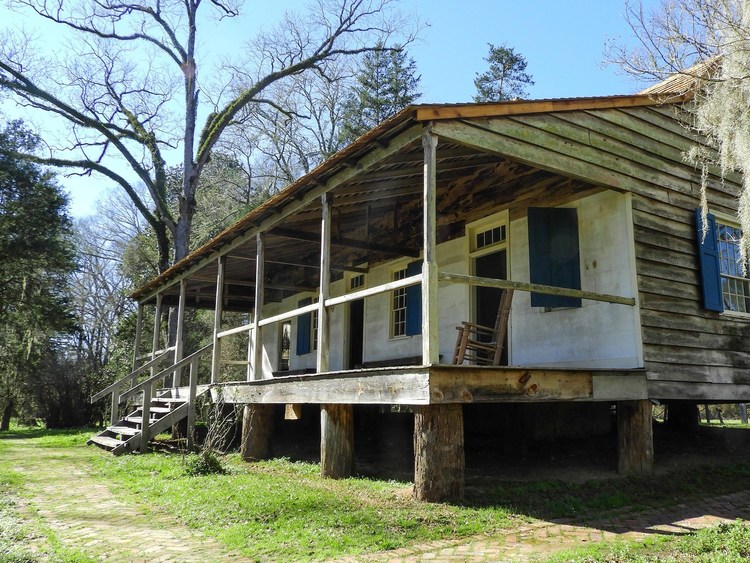
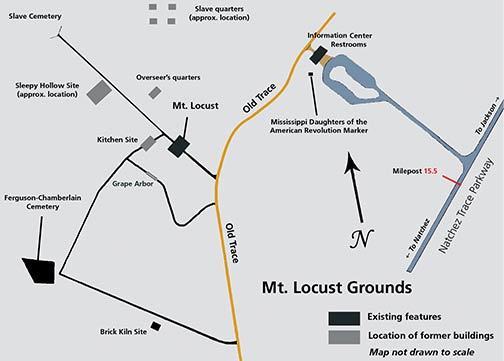
You are coming up on Mount Locust. The historic house here is one of the oldest structures still standing in this area. This location that has been settled on by many different people and under many different flags during its long history of human occupation that dates back as far back as 600 AD, long before Europeans first stepped foot in the area. There is archeological evidence of two separate American Indian occupations on the site. The first was between 600 and 800 A D during what is known as the Coles Creek culture and the second occupation was a village site in a field southwest of the historic house that consisted of at least seven mostly circular structures that dated back to between 1000 to 1350 A D during Plaquemine culture.
Centuries later, John Blommart began what would become known as Mount Locust around 1780, but his stay was short. Blommart’s former business associate, William Ferguson, and his wife Paulina purchased Mount Locust in 1784 and built the Mount Locust historic house, William and Paulina owned and operated the farm until William’s death in 1801. A short time later Paulina married James Chamberlain, an overseer at Mount Locust, and they continued to build the growing plantation.
Between 1785 and 1820, an increasing number of boatmen known as "Kaintucks," were floating flatboats down the Mississippi River to sell their goods at the markets in Natchez and New Orleans. Without an efficient way to navigate back up the Mississippi River, the boatmen walked north on the Natchez Trace to make their way home.
The end of the plantation system after the Civil War led to a slow decline at Mount Locust. Eventually the National Park Service took over the property in 1938, with the last of the Chamberlain leaving in 1944. Overall, Mount Locust was a home to the Ferguson-Chamberlain family for five generations.