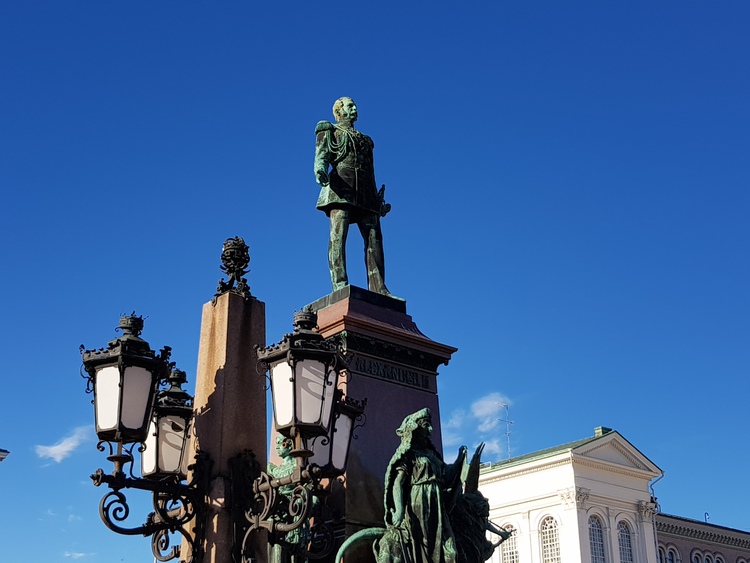
Statue of Alexander II
Welcome to the old historical heart of Helsinki!
The statue of Alexander II stands in the middle of Senate Square. Until 1809, Finland was part of the Kingdom of Sweden and for nearly 110 years was ruled by Russia as the Grand Duchy of Finland, Russia's only autonomous province.
In 1809 the first Tsar Alexander I, took possession of his new lands and in particular the fortress of Suomenlinna, in front of Helsinki and thus decided to found the new capital at this location. Helsinki became the capital in 1812.
Nearly half a century later, his nephew Alexander II, took over and convened in 1863, for the 2nd time, the General States to review the laws of 1809. As the first tsar to have been educated to govern Finland, Alexander II implemented several reforms that contributed to the economic, social and cultural development of Finland. Thus, Alexander II remained in the hearts of the Finns as a benefactor and his statue was erected long after his death and remains the only memory of a politician of that time, having contributed in particular to the movement of fennomania by establishing school for all and the right to education in the Finnish mother tongue as well as for women.
Among other important reforms, Alexander II founded with Governor Snellman, Director of the Bank of Finland, the Finnish Mark, strong currency until 2002, when Finland switched to the Euro.
In 1862, a year of famine, he appealed for European food aid and found help to feed the population of 1 million inhabitants, ⅕ of whom died of hunger before the arrival of provisions.
Alexander II also built thousands of kilometers of railways, which contributed to the economic development of Russia and the Grand Duchy of Finland, where the population climbed to around 65,000 thousand people in Helsinki while the capital had only 3,000 souls at the beginning of the century.
In 1862, despite the famine, Alexander II found the means to build the large red Orthodox church, the Uspensky Cathedral, which dominates the city of Helsinki with our white Lutheran cathedral, built thanks to the financial contribution of his father, Nicolas's 1st. Our white church, the Helsinki Cathedral is a symbol of the city and of the Lutheran state religion that the tsars have allowed Finland to keep.
-
Sunrise Serenade (1989), Starr Kempf
-
Space Needle (1978), Starr Kempf
-
Metronome (1981), Star Kempf
-
Opus Series (2003) and Oasis 64 (1995), Bill Burgess
-
Untitled, Lace Series (2012), Betty Ross
-
Lapping at the Peak (2017), Ball Nogues Studio
-
phase shift, (wattling) (2023), Martha Russo
-
Fool’s Gold (2021), Connor Dowdle