

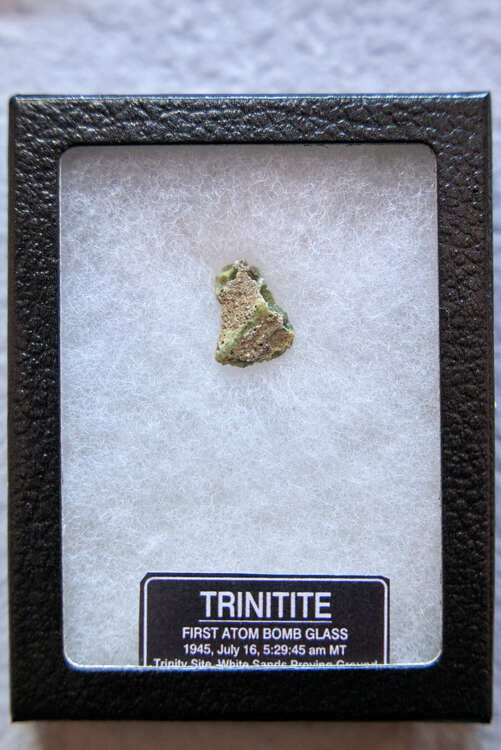
Welcome to an exhibit that tells the captivating tale of a small artifact carrying massive historical weight - a piece of Fused Sand from the Trinity Site, where the first atomic bomb was tested.
At first glance, this artifact may appear to be an ordinary stone. However, its origin and formation tell an intriguing tale of scientific breakthrough and its environmental impact. It is not just any stone, but a piece of glass, formed in a process unique to extreme conditions.
The Trinity Site, located in New Mexico, USA, was the location of the first-ever test of an atomic bomb, an event that unfolded on July 16, 1945, marking a significant turning point in human history. This test was conducted as part of the Manhattan Project, an extensive research effort during World War II that ultimately produced the world's first nuclear weapons.
The atomic bomb test at the Trinity Site was characterized by an intense heat, estimated to be several million degrees Celsius. This heat was so extreme that it actually melted the desert sand in the immediate vicinity, turning it into glass. This phenomenon, known as vitrification, is characteristic of nuclear detonations, with the immense heat and pressure fusing the sand into a glass-like material.
The artifact on display is a piece of this glass, a physical testament to the atomic age's dawn. It bears witness to the immense power of nuclear reactions and the profound impact human activities can have on the environment. This small piece of Fused Sand thus serves as both a scientific curiosity and a stark reminder of our past.