

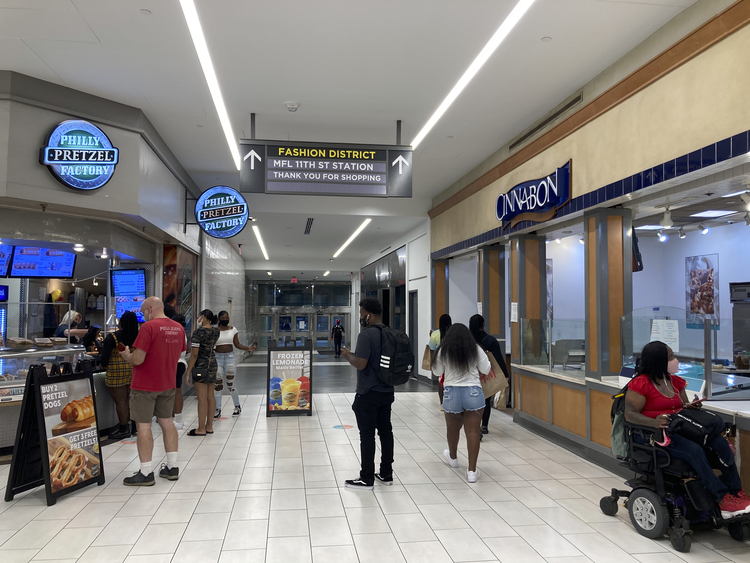
At the end of the last tour stop, you walked past the SEPTA waiting area to the glass panels overlooking the track level of Jefferson Station. Now retrace your steps by returning to the station ticket booth. Then look to the south--with your back turned to the ticket booth--and your view will terminate in a brightly lit underground passageway that runs east-west. Walk over to this passageway and you will find yourself in a recently renovated shopping mall, formerly known as the Gallery but renamed in 2019 as the Fashion District.
This is a multiblock space that occupies the concourse level, and in some places upstairs levels as well, of the Market East redevelopment. The mall was originally intended to attract suburban shoppers and commuters. The part of Chinatown east of 9th Street was sacrificed in part for the sake of this mall; as we noted earlier, several blocks of buildings were demolished for parking and an underground rail line leading to Jefferson Station, all of which were intended to provide easy access for suburbanites from the regional highway and rail systems to the Market East development. Since the suburbs are home to much of the region's population and suburban families are generally richer than their city counterparts, the city hoped to recapture some of that wealth by offering a marketplace that would appeal to them.
Despite many rebrandings and changes in store mix over the years, this mall was unable to attract a large suburban customer base. For one thing, suburbanites could find everything they needed in the malls in their hometowns. For another, the region's racial and ethnic divides intersected with class divisions to generate a fearful image of central-city shopping among suburbanites. Observing one of the street-level mall entrances, the sociologist Elijah Anderson wrote in 2011:
"All sorts of decidedly nonsuburban people occupy the stairs; homeboys, young black men in their twenties, and other black, brown, and white members of the underemployed and working poor are scattered around. The Gallery sits near the bus and subway transit lines that connect several black ghetto communities to this part of the city, providing the black poor with a degree of access that enables them to congregate here. Here they shop, hang out, or gather to socialize, talking and laughing out loud among their friends, their presence staking a claim on the Gallery and advertising what is to be encountered inside. ... To enter the Gallery, we must make our way past this phalanx of people and descend the steps, which is rather daunting to would-be shoppers from the suburban middle class."
In Anderson's narrative, the Gallery became a space utilized by Philadelphians, who were poorer and blacker than the suburban residents it was intended to attract. Over time the Gallery shrank as some of its shopping spaces were repurposed for offices. What you are seeing now is the result of a multi-year renovation undertaken by a real estate investment company that was intended to attract more shoppers by opening up the mall to the surrounding city blocks. The number of entrances was increased from 4 to 21, and some activity generators were moved to street level to enliven the outdoor space, such as the City WInery, which you may have noticed before you entered on the corner of Filbert and 10th streets. Even the new name, Fashion District, is intended to evoke the sense of being in a city neighborhood rather than a sealed mall.
Indoor shopping malls have been struggling to compete with other forms of retail for many years, and whatever it is called, the Fashion District is subject to the same pressures as malls everywhere. It has repeatedly lost and had to replace anchor department stores. The mall's newest anchor department store, Century 21, went out of business in 2020.
You are now invited to make your own observations of the spaces of Market East. From here, you may enter the Market-Frankford subway line, walk through the mall, or go back upstairs and visit Reading Terminal Market, a much older indoor marketplace, dating to 1893, at the corner of 12th and Filbert streets. Even during the coronavirus pandemic, these areas may be lively, though more socially distanced than in normal times. You may wish to compare Elijah Anderson's 2011 description on an NPR program with what you see in any of these spaces today:
"Anderson calls these spaces 'cosmopolitan canopies,' places where diverse people gather, and feel comfortable striking up sometimes surprisingly intimate conversations. 'It's really a point of cultural convergence,' Anderson tells NPR's Neal Conan, 'where all different kinds of people ... call "time out" on the segregated and sometimes quite contentious areas' outside of those melting pots."
Sources: "Bridging Racial Divides in 'Cosmpolitan Canopies'," Talk of the Nation, National Public Radio, April 4, 2011.
Sean McComas, "Gallery at Market East," Encyclopedia of Greater Philadelphia.
Ellie Silverman, "The Gallery is Finally Reopening as Philly's Fashion District." Philadelphia Inquirer, September 18, 2019.
Photo by Charles Starks