

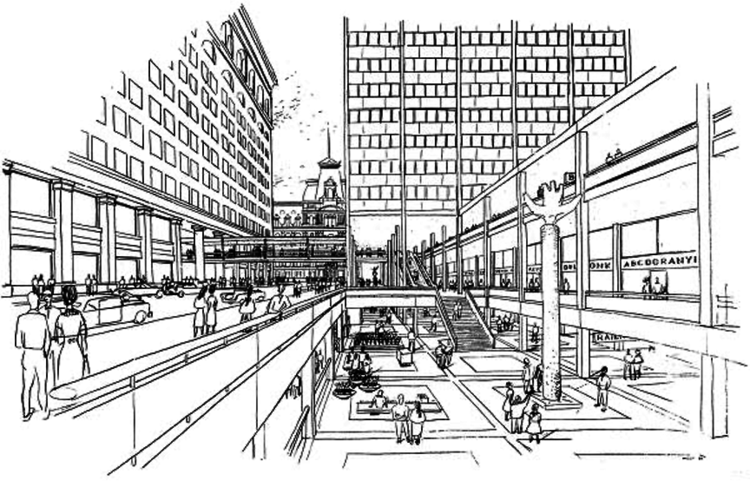
In 1959, Philadelphia City Planning Commmission (PCPC) director Ed Bacon first wrote about his vision for Market East, imagining the city as it might appear in 2009. Following Bacon's vision, the 1963 PCPC Plan for Center City sought to revive downtown retail; integrate and link city & regional transit systems; capture a greater share of the region's business economy; and provide a "sheltered” area for downtown business, shopping, work and entertainment spaces. Market East, a chain of redevelopment spaces extending along East Market Street between City Hall and Independence Mall, was to serve all of these purposes.
The plan was focused on supporting and stimulating business. The plan made the following claim for itself: “The plan is based on a belief in the initiative potential of the private enterprise system. Governmental activity is restricted to that minimum which is absolutely necessary to provide a framework which stimulates the imagination of private investors and which includes the physical facilities necessary to support those investments after they are made.”
As we have seen, one aspect of the Market East redevelopment plan that directly affected Chinatown was the transportation component: a railway tunnel going into the Market East development created a barrier on the eastern side of the community, although the land was later reoccupied by the Philadelphia Chinatown Development Corporation. Although the proposed highway ramps that would have also impacted Chinatown were not built, the Market East redevelopment project increased the demand for parking in the area, generating an economic use that competed for space with Chinatown business and drew vehicular congestion to the area. Part of Bacon's vision was to fill the north edge of downtown with parking to facilitate suburbanites’ arrival. They would then walk through the Market East enclosed shopping mall to reach the downtown office and retail core.
Commuter rail was also part of the vision, and the shopping center includes a large commuter train station known today as Jefferson Station. Market East itself created a five-block wall of parking and shopping space that separated Chinatown from the traditional downtown retail core along Market, Chestnut, and Walnut streets.
At this point, enter Jefferson Station from the southeast corner of Filbert and 10th streets. Use the stairs or elevator to go to the concourse level, where you will enter the main ticket booths and see the waiting area. From here, if you keep walking past the waiting area, you can see the tracks on the lower level through a large skylit area that admits light to from the street level. Take in this view and also look at the Planning Commission's 1960 vision of the project in the drawing shown above. What does it say about the experience of the city the Planning Commission wished to offer?
Image source: City Planning Commission drawing of the proposed Market East project, 1960.