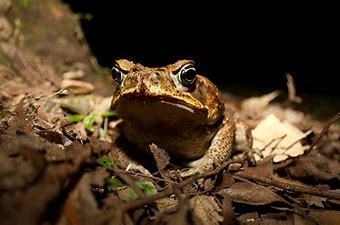
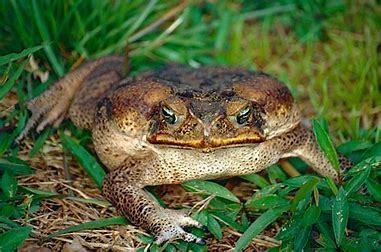
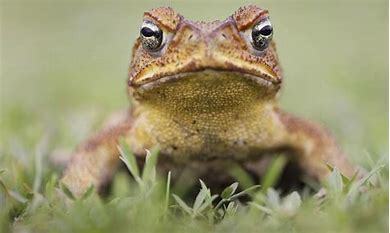
The cane toad (Rhinella marina), also known as the giant neotropical toad or marine toad, is a large, terrestrial true toad native to South and mainland Central America, but which has been introduced to various islands throughout Oceania and the Caribbean, as well as Northern Australia. The cane toad has poison glands, and the tadpoles are highly toxic to most animals if ingested. Its toxic skin can kill many animals, both wild and domesticated, and cane toads are particularly dangerous to dogs. When the toad is threatened, its glands secrete a milky-white fluid known as bufotoxin. Components of bufotoxin are toxic to many animals; even human deaths have been recorded due to the consumption of cane toads.
Most frogs identify prey by movement, and vision appears to be the primary method by which the cane toad detects prey; however, it can also locate food using its sense of smell. They eat a wide range of material; in addition to the normal prey of small rodents, reptiles, other amphibians, birds, and even bats and a range of invertebrates, such as ants, beetles, earwigs, dragonflies, grasshoppers, true bugs, crustaceans, and gastropods. Because of its voracious appetite, the cane toad has been introduced to many regions of the Pacific and the Caribbean islands as a method of agricultural pest control.