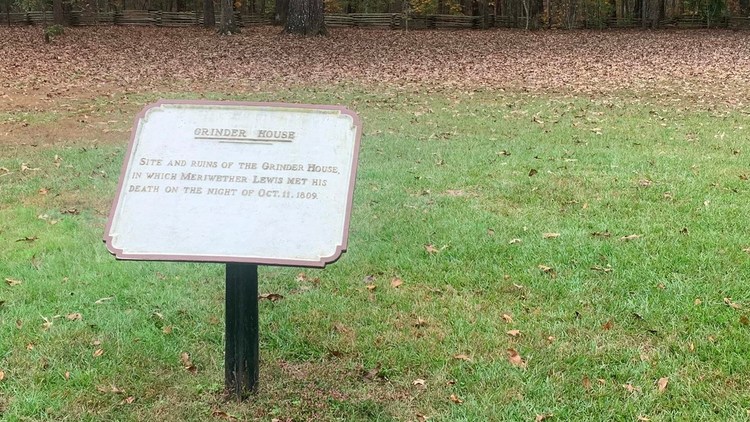
In September 1809, Meriwether Lewis was living in St. Louis as the appointed Governor of the Upper Louisiana Territory. He left St. Louis for Washington, DC, on September 4, 1809, to protest the War Department’s denial of payment vouchers that he had submitted for reimbursement. Lewis traveled with his personal servant, a free African American man named John Pernia (sometimes also spelled Pernier.)
Lewis traveled to Fort Pickering (modern-day Memphis, Tennessee) by boat and intended to proceed down the Mississippi River to New Orleans and then travel by ship to Washington, DC. Rumors of war with Britain and the thought of his journals from the Corps of Discovery falling into their hands changed his mind. He decided to travel overland to the nation’s capital.
Lewis left Fort Pickering on September 29th with John Pernia, Major James Neelly- the US Indian agent to the Chickasaw- and Neelly’s enslaved servant.
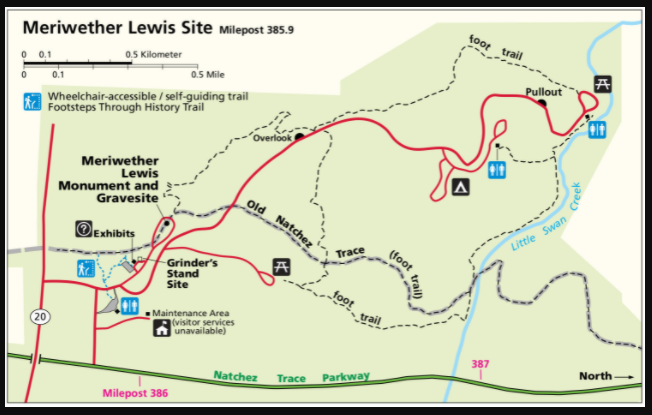
Lewis arrived at Grinder’s Stand on the evening of October 10, 1809. He was accompanied by Pernia and Neelly’s enslaved servant. James Neelly remained farther south, looking for horses that had escaped the previous night. Lewis stayed in the cabin while Pernia and Neelly’s enslaved servant stayed in the stables. Mrs. Grinder and her children stayed in the kitchen separate from the house. In the middle of the night Mrs. Grinder heard two gun shots and found Lewis bleeding from his wounds. By sunrise on October 11,1809, Lewis was dead. Historical accounts support the probability of suicide. When Neelly arrived later in the day, he arranged to have Lewis buried a few hundred yards from Grinder’s Stand.
Meriwether Lewis National Monument
On February 6, 1925, President Calvin Coolidge used the Antiquities Act of 1906 to establish Meriwether Lewis National Monument. The War Department managed the monument and the superintendent of Shiloh National Military Park was put in charge of the monument site.
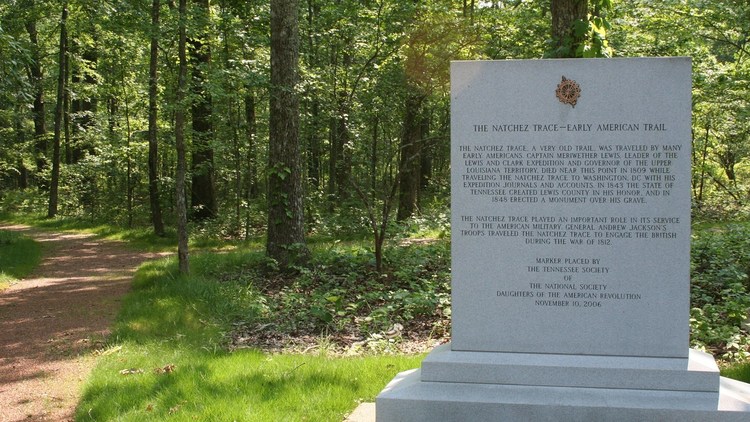
From 1926-1933 the War Department made several improvements to the site, including replacing the deteriorating cemetery headstones and straightening and repointing the Lewis Monument’s stone. The War Department also marked the sections of old Natchez Trace that traveled through the site.
Lewis Monument and Pioneer Cemetery
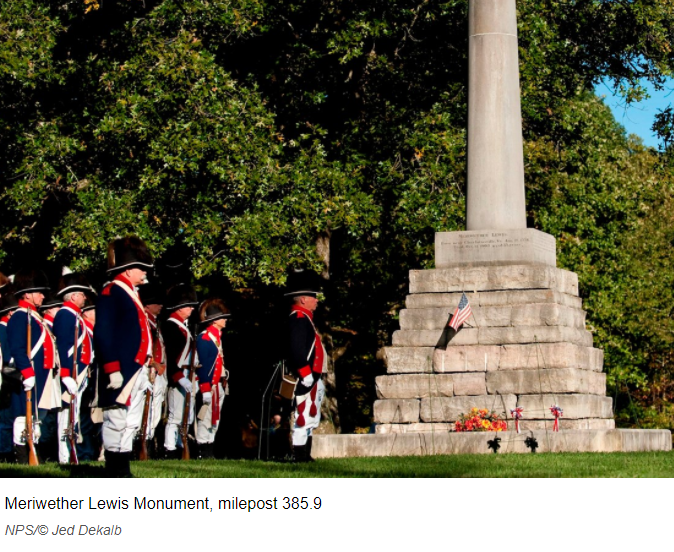
The Meriwether Lewis Monument was built in 1848 with funding provided by the Tennessee legislature. The legislation provided $500 “to preserve the place of internment, where the remains of General Meriwether Lewis were deposited.”
The most noticeable feature of the monument is the broken shaft. This was done deliberately and was a common custom in the 1800s. The broken shaft represents a life cut short by an untimely death.
The Pioneer Cemetery was first started in 1856, 47 years after Meriwether Lewis died and was buried. There are roughly 100 burials in the cemetery today. The War Department replaced the old and broken headstones with flat headstones in the 1920s. The flat headstones were restored in the early 2000s.