

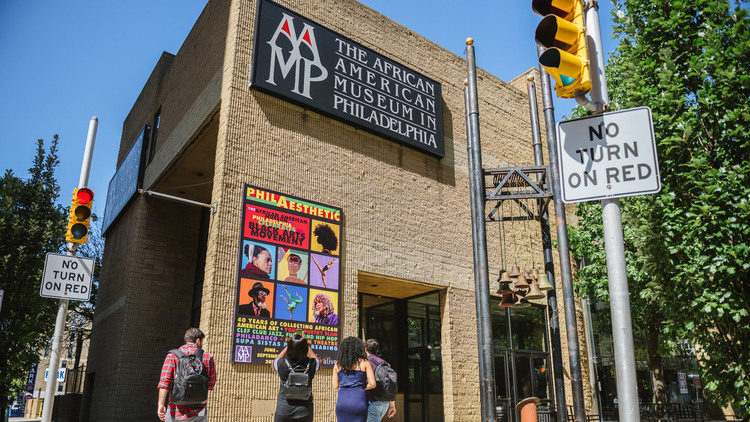
The African-American Museum in Philadelphia's official website provides the following description:
"Founded in 1976 in celebration of the nation's Bicentennial, the African American Museum in Philadelphia (AAMP) is the first institution funded and built by a major municipality to preserve, interpret and exhibit the heritage of African Americans. Throughout its evolution, the museum has objectively interpreted and presented the achievements and aspirations of African Americans from pre-colonial times to the current day."
Viewing this museum in its spatial context, however, reveals troubling aspects of its position within the framework of urban renewal. In general, urban renewal projects in Philadelphia caused considerable displacement of African-American residential and business communities. These communities tended to occupy the so-called dilapidated, abandoned, or uneconomical lands that the plans targeted, and they were not valued by the planning ideology of the time, which was especially concerned with appearance, property values, and the perception of white safety. It is therefore ironic that this museum sits on urban renewal land.
Further, unlike the other history museums in the Independence Mall area, the African-American Museum is isolated from the mall, surrounded by security complexes: a federal detention center to the south across Arch Street, and the Philadelphia police headquarters to the north on the same block, in addition to heavily fortified federal office buildings. This situates the museum between major institutions of the carceral state that have disproportionately impacted the lives of African-Americans in Philadelphia and throughout the United States. (At the time the museum was built, the detention center did not yet exist.)
Due to its isolation, the location has not proven conducive to attracting visitors, and the museum has long been seeking to move to a different site. Like other city-funded museums in Philadelphia, it has struggled to obtain the necessary funding to maintain its collections and mount exhibitions. In spite of these difficulties, the museum has strived to become an important node in the large networks of cultural institutions that underpin the African-American communities of Philadelphia, and it has obtained support from these communities.
Later in this tour we will see a concentration of institutions that support the city's Chinese and Chinese-American communities within the core of the Chinatown business district.
As you examine urban renewal plans and their impacts on various neighborhoods of Philadelphia, including Black communities in West Philadelphia and elsewhere, what can you conclude about the impacts of urban renewal on the city's ethnic communities? How have these communities responded? What signs of persistence and resistance can we see in the contemporary landscape?
Image source: Visitphilly.com